
Meadow Meat
How a project to save an endangered wading bird created a supply of high-welfare, hyper-local beef

I’ve been offered a lot of things in pubs: drugs, counterfeit perfume, smuggled cigarettes, the opportunity to spend the night with a man with a home-made tattoo. But the one suggestion that shocked me the most took place in an East London pub, when a keen entrepreneur invited me to buy some meat from the back of his car. “No thank you” I said, primly, “I’m not interested”.
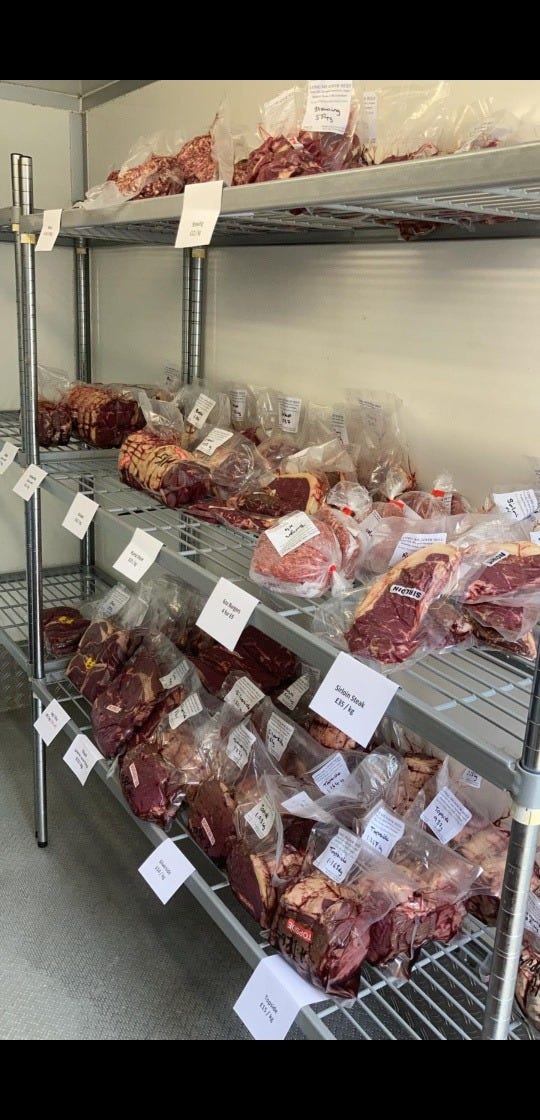
Five years later, I found myself stepping into a trailer parked up in a nearby Cambridgeshire village, packed with different cuts of beef, along with a large box of bloody bones. The meat comes from cattle born and raised in nearby fields. The herd feeds entirely on grass, which gives the beef a purity of flavour and wonderful marbled fat. All my hesitation at buying meat in a non-shop setting vanished. I felt excited to have such good produce right on my doorstep. I am a lifelong vegetarian, but my family are keen carnivores. I buy and cook meat regularly and prefer to know its provenance.
There’s a lot of debate around eating meat and particularly around eating ruminants. Veganism is burgeoning; the climate-conscious are concerned by methane emissions and efficacy of land use. This herd exists as a by-product of an environmental stewardship scheme. The cattle enjoy low-stress lives in a very high-welfare environment. The on-site beef sales keep food miles low too - so those looking to make their meat consumption “less-but better” may find this model of beef farming one they can embrace.
Welcome to Long Meadow Beef!
This story begins with the black tailed godwit, a long-billed, long-legged wading bird that nests in marshes and watery fields. A globally threatened species, numbers of black-tailed godwits have declined in Britain over the last 25 years. Farmers with fields around the Ouse Washes in Cambridgeshire were invited to join an environmental stewardship scheme, with incentives to turn their prime arable land over to grass and thereby encourage these rare birds to nest and breed.
The Runciman family has been farming the flat, low-lying land around Little Downham near Ely for generations. Like many local farmers, they focused on growing potatoes, onions and wheat. In 2000 they decided to take advantage of the stewardship scheme, planted their fields with grass, then bought some cattle to keep the grass down.
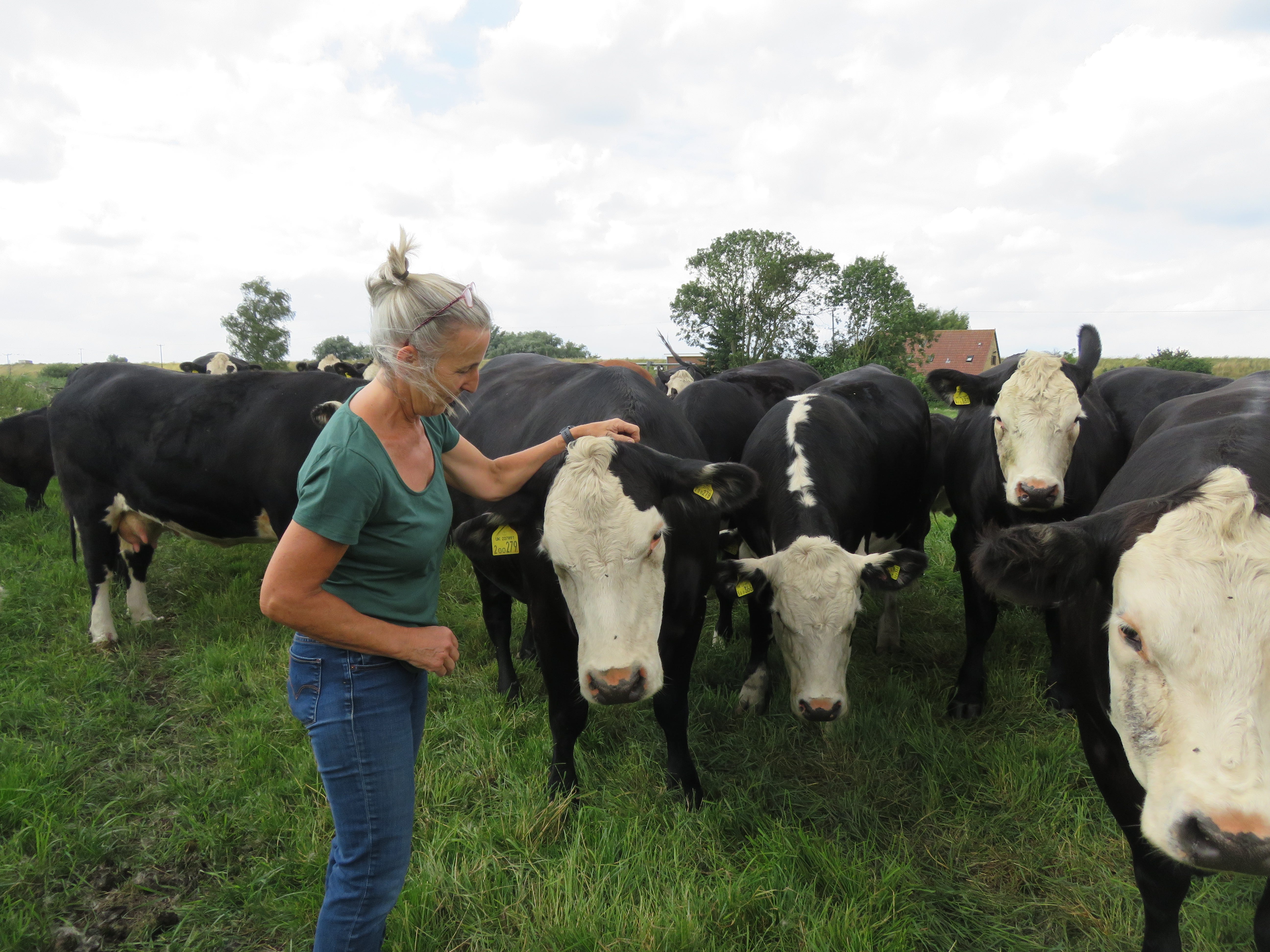
A small herd of heifers and cows gathers at the end of a lush, green field in Pymoor, a short distance from the family’s house. One section of the field houses a “scrape” – a shallow dip of water to attract wildlife. The cows vary in colour: some have black bodies and white faces decorated with tiny curls; others are reddish brown. The females are clustered around a young bull with a deep red coat. The bull is a Hereford, the females Hereford crossed with Angus. Both breeds are native to the UK and have been grazing British fields for centuries.
“We left the stewardship scheme after ten years but kept the cattle.” explains Catherine Runciman. “We have since diversified into making haylage [fermented hay that is preserved in plastic] for horses. Cattle work well alongside the business, as their grazing improves the quality of the grass for making haylage.”
Keeping cows on pasture seems the most natural and logical way to raise them. Studies suggest that grass-fed beef has better omega 3 nutrients than grain-fed beef and is marginally lower in calories, making it the healthier choice for consumers.
“Our cattle are completely grass-fed because it is simple” says Catherine. “We have got grass. Our cows are native breeds and don’t need anything else”.
Some continental breeds of beef cattle, like Charolais and Limousin are thicker set and don’t fatten well from grass alone. Farmers have to supplement their feed with concentrates to get the cattle to the right weight for slaughter. The supplementary feed may take the form of corn, or nuts, or in East Anglia (as so many are grown in the neighbouring fields) potatoes.
The Runciman cows eat haylage during the winter. This is made from grass in the fields they graze in warmer months - so their diet is consistent year round.
I came across this local grass-fed beef by chance; an algorithm on Facebook picked up that I am a food writer, but ignored the fact that I am vegetarian. It flagged up occasional sales of hyper-local beef just 3 miles from my home. I signed up for email alerts to let me know when the next sale would take place and one Saturday, walked the three miles from my home to a large, refrigerated trailer parked in the driveway of a house on the main village street. I bought two sirloin steaks and a kilo of shin. I may be vegetarian, but my family are caveman-level carnivores.
I cooked the steak that evening, interested to see the reactions of my family. I fried it very simply in butter and served it rare. My daughter waved away the ketchup: “Get that out of here,” she growled, a cube of meat speared on her fork. “This steak is so delicious it doesn’t need anything”. I asked her what it tasted of “It’s really beefy” she said. “Just pure beef, It’s perfect”.
The Runciman cattle enjoy a high quality of life. Calving takes place annually in February and March. Calves stay with their mothers until they come into the yard for the winter in late November/December. They graze in family groups, or with their peers, moving from field to field across the fen. “They do make friends” says Catherine “they groom each other”. Aside from vaccinations for lungworm and tetanus, the cattle are not given medication unless they get ill. The Runcimans chose a natural poll breed (cattle that are born without horns) to avoid distressing horn removal interventions. These beasts are so used to humans that they can be handled without being put into a pen or a press.
A white-faced cow pushes through the small herd of 20 and approaches Catherine Runciman. “Hello 279” she says, addressing the cow by the number on the tag in her ear. The cow lowers her head for a scratch and moves her body round for a back rub. One of her bovine friends approaches me with a suspicious look “They are interested in you, because you are a stranger” explains Catherine.
Being surrounded by twenty cows and a bull might feel frightening if they were a different breed. Hereford and Angus cattle are well-known for their calm, placid natures and their lack of aggression. “Herefords are the Labradors of the cow world” says Edward Runciman. “We used to have Limousin and they could be quite loopy. But our gang now are practically horizontal”.
It takes 18 months to 2 years for a steer or heifer to be ready for slaughter. There is no minimum weight, practice makes the farmers able to judge by eye whether an animal is ready. Most of the animals are sold to a local cooperative who deal with the transport and slaughter, but just over a year ago the family decided to start small local sales of their beef.
These meat sales take place on consecutive Saturdays every couple of months. Customers sign up for email alerts so they can pre-order a favourite cut, or just turn up on the day of the sale. Two cows are slaughtered and every single part of the animal is either sold or given away. “It annoys me when people waste food” says Edward Runciman. “It is just like meat is a commodity and it is not. It is from a living thing.”
The animals are dispatched at abattoirs about one hour’s drive away. The Runcimans have never got used to the hard job of sending the cattle on their last journey. “I detest the killing” says Edward. “I try not to be in the yard when they go” says Catherine. “It’s a horrible dilemma – you are there when they calve and you do get attached. The older you are the harder it gets. We had a few cows this spring we had to get rid of – they are 8 or 9 years old now so it is probably better not to be breeding from them. We are supposed to be a business and need to avoid extra expense but these were fantastic cows and that was horrible. It was a group and they went together. At least they were with their friends. However you look at it, it is not nice”
The beef is hung for 3 weeks before it is ready for sale. This improves both the texture and flavour.
Meat sales have been successful -the high quality of the produce has seen customers returning, some with larger orders. In future, the Runcimans may move to having monthly sales in order to meet demand and Catherine is thinking of ways to encourage people to buy less familiar cuts of beef. “All the steaks are in high demand and short ribs, skirt and brisket are popular too,” she explains “But some of the less popular cuts are the tastiest of all, you just need to know how to cook them”.
As for the rare and endangered godwits, it seems they are still reluctant to nest among the meadow grass; the burgeoning population of badgers poses too great a threat to their survival. A pair were rumoured to have settled in the area last year and hopes remain that they will eventually repopulate the washes and marshes. In the meantime, locals can enjoy the by-product of the project.
Further reading
About Us | Little Downham | Long Meadow Beef
Pasture for Life – Certified 100% grass-fed meat, milk and dairy